
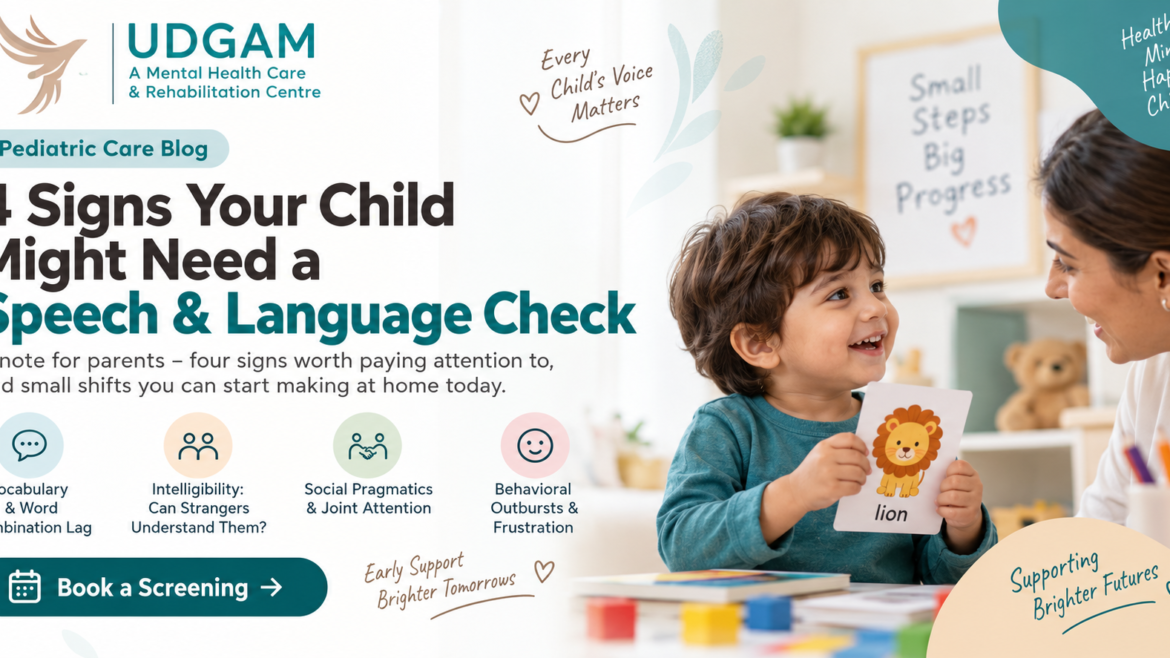

Pediatric Care Blog
A note for parents
Four signs worth paying attention to, and small shifts you can start making at home today.
“He’ll talk when he’s ready.”
It’s the easiest advice to give when it’s not your child sitting across the dinner table, pointing instead of speaking, watching you translate for them to the rest of the world. You smile at the well-meaning relative who says it. You nod along at the playground when another parent shrugs it off. But somewhere underneath that nod is a quiet, nagging feeling that something isn’t quite lining up with what you see in other kids his age.
That feeling is worth listening to.
Every child develops at their own pace, and that’s true. Some toddlers are chatterboxes by 18 months, others take their time and catch up beautifully by three. But waiting for a speech delay to fix itself on its own is a gamble with real stakes attached. Language isn’t a skill that develops in isolation, it’s cumulative. The vocabulary, sentence structure, and listening skills a child builds at age 2 become the scaffolding for reading at age 5, writing at age 7, and confident classroom participation for years after that. A small gap today can quietly widen into a much bigger one if it goes unaddressed.
This doesn’t mean every parent should panic over a late word or a mispronounced sound. Most kids are fine. But there’s a meaningful difference between “still developing” and “showing signs that need a professional look,” and most parents are never taught how to tell the two apart. That’s what this guide is for.
Here are four red flags worth paying close attention to, along with small, doable shifts you can start making at home today, and what to actually expect if you do decide to book a screening.
Vocabulary & word combination lag
Vocabulary size is one of the easiest things for parents to track, and also one of the easiest things to misread. A late talker who is otherwise engaged, curious, and communicating through gestures may simply be a late bloomer. But certain patterns are worth flagging early.
By 18 months: most toddlers have somewhere between 10 and 50 words, along with a growing range of consonant sounds they experiment with. If your child has fewer than 10 to 20 words, or relies on a very narrow set of sounds no matter what they’re trying to say, that’s worth noting.
By 2 years: two-word combinations typically appear, things like “more milk” or “bye-bye daddy.” If your child isn’t combining words yet, or their speech is mostly echolalia (repeating phrases they’ve heard, without generating spontaneous combinations), that’s a second signal.
Echolalia itself isn’t automatically a red flag — many typically developing toddlers echo phrases as part of learning language. The concern is when echoing is the primary way a child communicates, without much original language underneath it.
Intelligibility: can strangers understand them?
This is one of the clearest, most objective markers available, because it doesn’t rely on you guessing whether your child is on track. It relies on a simple, real-world test: can someone who doesn’t know your child understand what they’re saying?
~50%
~75%
~100%
Expected intelligibility to strangers, by age. Parents and regular caregivers develop an almost unconscious fluency in their own child’s speech, which is a wonderful thing, but it can also mask a delay, because you’re unconsciously filling in gaps a stranger, teacher, or new babysitter simply cannot.
Social pragmatics & joint attention
This is the category parents most often overlook, because it doesn’t show up as “not talking.” It shows up as a quieter, more subtle disconnect in how a child engages socially, and it often appears before spoken language delays are even noticeable.
- Limited eye contact, especially when paired with expressive language delays
- Difficulty with the back-and-forth rhythm of babble-and-response, or later, conversational turn-taking
- No joint attention by 14–16 months — your child doesn’t point at or show you an object simply to share interest in it
Joint attention is one of the earliest building blocks of communication itself. Before a child says their first word, they’re already learning that sharing attention with another person about the same object or event is the whole point of talking in the first place. An experienced pediatric team can tell the difference between a language delay, a broader developmental difference, or simply a shy temperament — which is exactly why a professional screening matters here.
Behavioral outbursts & frustration
Frequent meltdowns, biting, hitting, or aggressive pointing are rarely just “bad behavior.” More often, they’re communication breakdowns wearing a different costume.
Imagine trying to tell someone something urgent, that you’re hungry, that something hurts, that you want a specific toy, and having no reliable way to get the message across. Now imagine you’re two or three, with limited impulse control and an already-overloaded nervous system. Frustration doesn’t stay contained. It comes out as a meltdown, not because the child is being difficult, but because their words haven’t caught up to their needs yet.
What actually happens in speech therapy?
A lot of parental hesitation comes from simply not knowing what therapy looks like. The image many people carry — drills, worksheets, a child forced to sit still and repeat sounds — is almost never the reality, especially for young children.
Speech therapy isn’t a boot camp. It’s a guided bridge between where a child is right now and where they’re developmentally ready to go next, built through play, connection, and repetition.
Play-based assessment
Understanding how a child comprehends language, plays, and expresses intent, all within an environment that feels natural and low-pressure to them.
Targeted modeling
Repeated, high-frequency exposure to the specific sounds and language structures a child needs, so their own brain starts to pick up the pattern.
Parent coaching
Small, practical habits you can fold into car rides, mealtimes, and story hour — so language-building becomes part of everyday life.
Try this at home: stop vs. swap
One of the simplest, highest-impact changes a parent can make doesn’t require a therapist at all. It’s a shift in how you talk to your child.
Golden rule: reduce test questions, increase rich, natural language input. Children absorb far more from hearing language modeled around them than from being asked to perform it on command.
Trust your gut
A screening isn’t a diagnosis, and it definitely isn’t a life sentence. It’s clarity. If you’ve been lying awake replaying dinner-table moments, or quietly wondering whether you’re overreacting, a 30-minute evaluation can give you one of two things: genuine peace of mind, or a clear, actionable roadmap forward. Either way, you stop guessing, and that alone is worth a great deal.
Parents are often the first to notice when something feels off, long before it shows up on a formal checklist. Trust that instinct enough to ask the question. The earlier a potential delay is understood, the more time your child has to close any gap comfortably, through play rather than pressure.
Navigating a language leap with your little one?
Comment or DM “MILESTONE” to connect with our pediatric care team at Udgam for guidance.